
At ParentShield, we have always believed that a child’s mobile network should do more than just connect calls. It should actively work to keep children safe, and do so in a way that respects the privacy of every family we serve.
Today, we are proud to introduce something we have spent a long time building carefully and thoughtfully: AI-powered call analysis. Every call made or received on the ParentShield network can now be automatically transcribed, summarised, and assessed for safeguarding concerns — entirely by machine, with no human ever needing to listen to a single second of audio.
This post explains what we have built, how it works at a high level, and — most importantly — why the way we have designed it means your family’s privacy is protected at every step.
Why Analyse Calls at All?
ParentShield exists because children need a mobile network that puts their safety first. Our subscribers are primarily children aged 3 to 18, and we take that responsibility seriously.
The reality is that the most serious risks to children online and on mobile networks — grooming, exploitation, coercion, bullying — very often happen through ordinary-looking phone calls. A predator does not announce themselves. Harmful contact often begins with what appears to be a perfectly normal conversation, escalating gradually over time.
Historically, there has been no practical way to monitor calls for safeguarding concerns without a human listener — which creates an obvious and insurmountable privacy problem. You cannot have staff listening to children’s phone calls. It is intrusive, it does not scale, and it is simply not acceptable. There may be a serious risk of harm revealed deep in a 1 hour long conversation. Being able to pick these out means risks can be spotted quicker and more efficiently.
AI changes that equation entirely.
What Happens to a Call
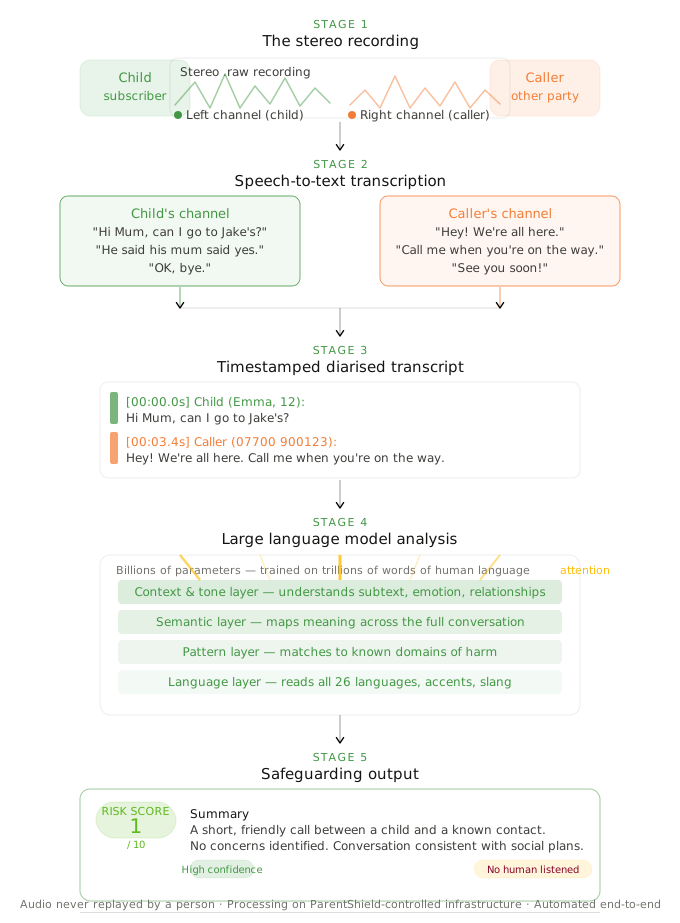
When a call completes on the ParentShield network, a recording is made — in stereo, with the two sides of the conversation on separate audio channels. This is the last moment at which humans ( the two parties on the call ) are involved. From this point forward, the entire process is automated and no human is involved.
The audio is passed to our transcription system, which converts speech to text. The two channels are processed separately, meaning the system knows which words were spoken by which party — your child, or whoever they were speaking with. This produces a timestamped, speaker-labelled transcript: not just a wall of text, but a structured record of who said what and when. The system knows who is speaking, who. is listening, if there are repeats, pauses, negotiations or objections.
That transcript is then passed to our analysis system, which reads it, assesses it, and produces a concise summary along with a safeguarding risk score. The whole process — from call ending to completed analysis — takes a matter of seconds to a couple of minutes depending on call length.
The audio recording itself is retained only as long as necessary and is never replayed by a human as part of the analysis process. Call summaries are only available where subscribers have opted in to call recording. Without call recording, no summary will be available.
How Does AI Actually Work?
It is worth taking a moment to explain, in plain terms, what artificial intelligence actually is — because the term gets used so loosely that it has almost lost meaning.
The AI systems we use are called Large Language Models, or LLMs. These are a class of software that has been trained on enormous quantities of human-generated text — books, articles, conversations, research papers, code, and much more — in order to develop a remarkably sophisticated understanding of language, context, and meaning.
The scale involved is genuinely difficult to comprehend. Modern large language models are trained on datasets measured in trillions of words. The human brain contains roughly 86 billion neurons; a large language model may have hundreds of billions of parameters — the numerical values that encode everything the model has learned. Training such a model requires months of computation on thousands of specialised processors running simultaneously, consuming more electricity than a small town.
What emerges from that process is not a lookup table or a set of rules written by a programmer. It is something closer to a distillation of an enormous breadth of human knowledge and linguistic understanding — a system that can read a piece of text and understand not just the words, but the tone, the subtext, the emotional register, and the context.
This is why LLMs are so well suited to tasks like call analysis. A simple keyword filter looking for “bad words” is trivially easy to circumvent and produces enormous numbers of false alerts. An LLM reads a conversation the way a thoughtful person would — understanding that the same words can mean entirely different things depending on who is speaking, to whom, in what context, and with what apparent intent.
How Speech Becomes Text
Before the AI can analyse a conversation, the audio must be converted to text. This is the job of our speech-to-text transcription system — a separate AI model specialised specifically for the task of understanding spoken language.
Modern speech recognition has advanced to the point where it can accurately transcribe natural, conversational speech across a wide range of accents, ages, and audio quality conditions. Our system processes the two channels of a stereo recording independently, producing a transcript in which every line is attributed to the correct speaker.
The result looks something like this:
[00:04.2s] Child (age 11): Hiya, are you coming over after school?
[00:07.8s] Caller: Yeah, ask your mum if it’s alright. What time does she get home?
From this structured transcript, the analysis AI can begin its work.
How the Analysis Works
The analysis stage is where the real safeguarding intelligence lives. Our system has been carefully designed around a detailed understanding of the known domains of harm that affect children and vulnerable people on mobile networks.
These domains include — but are not limited to — grooming and sexual exploitation, peer bullying and coercion, drug supply and county lines exploitation, financial exploitation and fraud, radicalisation, sextortion, and indicators of self-harm or abuse.
Each of these domains has known patterns. Grooming, for example, does not typically begin with explicit content — it begins with excessive flattery, boundary-testing, gift-giving, requests for secrecy, and the gradual establishment of a private communication channel away from trusted adults. An AI system trained to recognise these patterns can identify early-stage grooming from a conversation that might appear entirely innocent to a casual observer.
Our analysis produces, for every call, a structured output that includes a plain-English summary of the call’s content and tone, a risk score from 0 to 10 based on a detailed rubric, a confidence rating reflecting how clear and complete the transcript was, the specific risk factors observed in the conversation, and a contextual explanation of why that score was given.
A score of 0 or 1 means the call is clearly benign — a child chatting with a friend about school, a parent arranging a pickup. These calls require no further attention. As the score rises, the nature and specificity of the concern increases, with scores of 8, 9, or 10 reserved for calls showing direct evidence of exploitation, abuse, coercion, or immediate risk to life.
Crucially, the system is designed to err on the side of caution. When in doubt, the score is higher rather than lower. The age of the subscriber is factored into the assessment — language or topics that are unremarkable between two seventeen-year-olds may be deeply concerning in a call involving a much younger child. A significant age gap between speakers, combined with inappropriate familiarity, will increase the score accordingly.
Privacy by Design
We are acutely aware that building a system that analyses the content of telephone calls carries significant privacy obligations. We have not taken this lightly. The entire pipeline has been designed from the ground up with privacy as a core requirement, not an afterthought.
Here is how that works in practice.
No human listens to calls. This is the central privacy guarantee of the system. The entire process — from audio recording through transcription to analysis — is automated. There is no queue of staff reviewing transcripts, no sampling process in which calls are pulled for human review. The AI reads the transcript; no person does.
Audio is processed and not retained as a primary record. The stereo audio recording serves as the input to the transcription process. Once transcribed, the text is what matters for analysis purposes. Audio retention follows strict policies and is not used for replay or human review as part of the analysis workflow.
Processing happens on infrastructure we control. The transcription and analysis of calls does not involve sending audio or transcripts to third-party cloud services for processing. Our AI infrastructure runs on dedicated hardware operated by ParentShield — meaning call content does not leave our controlled environment during processing.
The system is designed to identify patterns, not to surveil. The output of the analysis is a risk score and a summary — not a verbatim transcript handed to a person. High-scoring calls may trigger a review process, but that process is governed by strict policies and involves only the minimum information necessary.
Subscribers and parents are informed. Transparency is a fundamental principle. The existence of call analysis is disclosed as part of the ParentShield service, consistent with our belief that families should understand how the network works to protect their children.
Improving the system. ParentShield has also built a system that allows Parents themselves to provide feedback and improvements all without needing to share any of the details. No ParentShield employee will ever have access to any of the media or transcripts – as it is with calls or SMS information. Information from parents is used to monitor and improve model data.
But what about the planet!!!
The AI systems you might use in other tasks are VERY wasteful. They can make music, draw, make videos, compose poetry… We don’t need any of that. Our ‘experts only’ AI model is only trained on Data and realms of harm identified by reputable sources. It does what it needs to do well, and we don’t need overkill, or many Kw of servers.
Our current AI suite ( in our own NoC ) consumes less electricity than it takes to light up just one hightstreet shop.
The Bigger Picture
What we have built is, to our knowledge, one of the most sophisticated automated safeguarding systems deployed on a children’s mobile network anywhere in the World. It combines state-of-the-art speech recognition, speaker diarisation, and large language model analysis into a pipeline that processes calls at scale — thousands per day — and does so in a way that actively protects rather than undermines the privacy of the children and families it serves.
The facts around AI that make this possible are remarkable. The models that power this system have, in effect, read more text than any human could read in a thousand lifetimes. They have developed an understanding of language subtle enough to distinguish between a child excitedly telling a friend about a new game and a child being pressured into something they are uncomfortable with — even when the words on the surface look similar.
That capability, applied thoughtfully and with the right safeguards, is genuinely transformative for child protection.
We believe this is what a children’s mobile network should do. Not just carry calls, but actively work — quietly, automatically, and privately — to make sure every call is a safe one.